Futuristic Screens: Augmented Reality Glasses
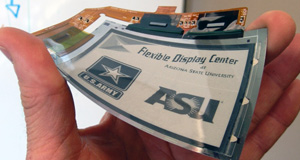
In 2009, it turns out that the future of display technology is decidedly more complex than a simple evolutionary advance from one technology to another, because multiple display technologies are on the near-term horizon, and they'll most likely all coexist with one another in a display ecosystem that consists of many different niches and market segments. None of them will enjoy the kind of hegemony that CRT had in its heyday. In the near-term, a new generation of LCD panels is poised to revolutionize the television market with power-sipping displays that are 1 inch thin, boast very high contrast ratios, and can hang on the wall like a framed poster. The secret is in the new style of backlighting—the new displays replace compact fluorescent lamps with white LEDs that use much less power and enable a thinner screen profile. |
While the LCD-backlit LED has so far brought incremental advances to the mobile-computing space, the place where it's poised to have the most dramatic impact is in televisions. A high-end LCD HDTV has a contrast ratio of about 30,000:1, whereas LED LCDs have contrast ratios between 1,000,000:1 and 2,000,000:1. Power consumption and weight savings of LED-backlit LCDs are between 30 and 50 percent, and these savings translate into very attractive form factors—the latest LED LCD TVs from Sharp and others are only a little over 1 inch thick, despite their large (46 inch and up) screen sizes.
Research firm iSuppli recently predicted that the percentage of these LED-backlit TVs will grow from 3 percent of TV sales in 2009 to 39 percent in 2013.
With LED LCD poised to dominate at ever larger screen sizes, the smaller end of the screen size spectrum will soon belong to organic LED (OLED). The viewing angle for OLED screens is very wide, and it derives its unique visual effect from the fact that each individual pixel on the screen consists of a glowing LED. So, unlike even the LED LCD technology, an OLED needs no backlighting because the pixel grid itself is an array of colored lights. Such "active-matrix" OLED displays are also brighter than active-matrix LCD technology (TFT-LCD), and they maintain 100 percent of their color gamut at all gray levels.
Not only do OLED screens have every other screen technology beat in the contrast and brightness departments, they're also thinner. Sony's 11-inch XEL-1 is currently the only commercially available OLED TV, and it boasts a thickness of 3 millimeters. LG has announced a 15-inch OLED TV that will be a scant 0.85 millimeters thick, which will launch Korea at the end of this year.
You might think that with all of these benefits, OLED would be poised to take the living room by storm and put the brakes on the aforementioned LED LCD HDTV trend. Unfortunately, OLED has been confined to small screen sizes, and that will probably continue to be the case for a while.

